
Kew’s Millennium Seed Bank celebrates 25 years of collaborative plant conservation with partners globally

Under embargo until 21 October 2025: The Royal Botanic Gardens, Kew, is proud to celebrate the 25th anniversary of the Millennium Seed Bank (MSB), the world’s largest wild plant seed bank and home to some of the planet’s most precious biodiversity. Located at Kew’s wild botanic garden in Wakehurst, Sussex, UK, the MSB houses nearly 2.5 billion seeds from over 40,000 species, collected and banked through a huge collaborative effort involving 279 partners from 100 countries. This partnership has made the MSB what it is today, both a vital safeguard for biodiversity and a dynamic hub for research, restoration and collaboration. With 45% of all flowering plants at risk of extinction, its role couldn’t be more important. The MSB goes beyond collecting and storing seeds for the future. Its collections are actively being used by researchers and conservationists worldwide to restore habitats and revive degraded ecosystems; support local communities by improving livelihoods and food security; conduct cutting-edge research on climate adaptation, cryopreservation and seed longevity; and train the next generation of seed experts. Since 2010, the MSB has contributed to over 100 restoration projects in the UK and around the world alongside partners globally and in the last five years provided training on best practice for seed banking to over 850 professionals from 44 different countries, both at the MSB and at partner institutions in countries including Ghana, Greece, Indonesia, Madagascar and Mozambique. Dr. Shakeel A. Jatoi, Curator, National Gene bank, says: Dr. Amir Sultan, Programme Leader, National Herbarium of Pakistan, says: 25th anniversary events The anniversary will see the launch of a new series of Kew’s award-winning podcast, Unearthed: The Need for Seeds with Kew’s Ambassador for Wakehurst, Cate Blanchett, available from 21 October on Apple Podcasts and Spotify. Kew is also launching a £30m Seed Future Fund to raise funds to support the MSB’s critical scientific mission to prevent plant extinction, restore species-rich habitats and provide nature- based solutions. People can make a gift to the MSB 25 appeal by visiting www.kew.org/seeds. For visitors to the UK, there is an opportunity to visit the MSB at Wakehurst throughout the year, with regular family engagement activities that tell the story of seed banking for a younger audience. Looking ahead to the next 25 years In line with the renewal of Kew’s Science Strategy, the MSB and Kew scientists are developing a strategy specifically on seed science, conservation and use. Charlotte Lusty, Head of Seed Collections at the MSB says: “The aim will be to facilitate use of the collection towards conservation and restoration actions on the ground right now. In other words, there is no time to waste. The strategy will help shape the collection and develop seed bank’s roles in ecological restoration and providing nature-based solutions while preventing plant extinction. Wider engagement with partners to discuss and develop these future plans will be key to developing such roles and growing and strengthening the seed bank community globally.” Content download links: About the Plant Genetic Resources Institute (PGRI–NARC): About Kew Science Kew Science is the driving force behind RBG Kew’s mission to understand and protect plants and fungi, for the well-being of people and the future of all life on Earth. Over 600 Kew science staff work with partners in more than 100 countries worldwide to halt biodiversity loss, uncover secrets of the natural world, and to conserve and restore the extraordinary diversity of plants and fungi. Kew’s Science Strategy 2021–2025 lays out five scientific priorities to aid these goals: research into the protection of biodiversity through Ecosystem Stewardship, understanding the variety and evolution of traits and uses in plants and fungi through Trait Diversity and Function; digitising and sharing tools to analyse Kew’s scientific collections through Digital Revolution; using new technologies to speed up the naming and characterisation of plants and fungi through Accelerated Taxonomy; and cultivating new scientific and commercial partnerships in the UK and globally through Enhanced Partnerships. One of Kew’s greatest international collaborations is the Millennium Seed Bank Partnership, which has, to date, stored more than 2.4 billion seeds of over 40,000 wild species of plants across the globe. In 2023, Kew scientists estimated in the State of the World’s Plants and Fungi report that 3 in 4 undescribed plants globally are already likely threatened with extinction.
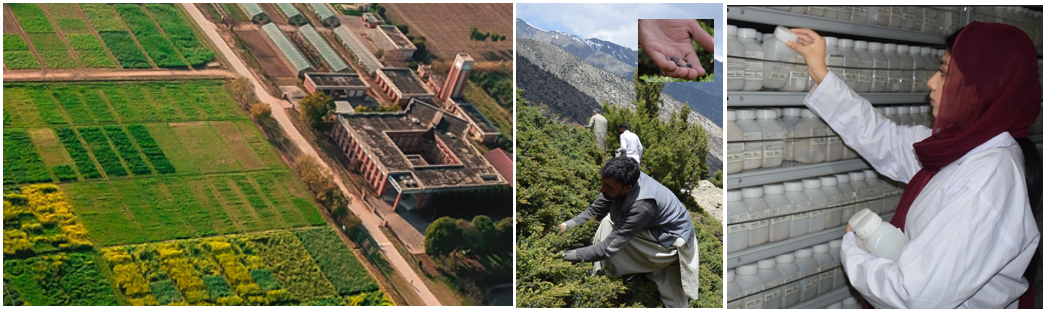
The National Genebank of Pakistan at the Plant Genetic Resources Institute (PGRI), under Pakistan Agricultural Research Council, Islamabad, has been an active partner of the Millennium Seed Bank (MSB) since 2015. Through the Crop Wild Relatives (CWR) project funded by the Crop Trust and the Medicinal & Aromatic Plants (MAPs) project supported by RBG-Kew, the Genebank surveyed and conserved seeds of over 400 wild and economically valuable species. These initiatives greatly strengthened national expertise in seed conservation, herbarium management, and data documentation. Extensive field expeditions across Pakistan’s mountain and arid regions expanded knowledge on species distribution and the threats they face. Collectively, the projects have made a significant contribution to Pakistan’s ex-situ conservation objectives and enhanced its integration within the global seed conservation network.
‘Our collaboration with the Millennium Seed Bank has been instrumental in advancing seed conservation science and in building national capacity for safeguarding Pakistan’s rich flora. Through the MAPs project and CWR project, we have documented and conserved several threatened species that hold vital ecological and medicinal importance. We look forward to expanding this partnership to strengthen restoration and sustainable use of plant genetic resources.”
“Collaboration with RBG Kew and the Millennium Seed Bank has been invaluable for the National Herbarium. Training at Kew, along with the provision of herbarium cabinets, microscopes, and key floras, greatly enhanced our capacity. Through the CWR and MAPs projects, we collected and documented numerous plant specimens from across Pakistan, significantly enriching our collections and strengthening our role in national and global plant conservation.”
The Plant Genetic Resources Institute (PGRI) is a constituent institute of the National Agricultural Research Centre (NARC), Islamabad, mandated to conserve, characterize, and utilize plant genetic resources for food, agriculture, and environmental sustainability. The National Genebank, established under PGRI, maintains ex-situ collections of crop germplasm, crop wild relatives, and medicinal and aromatic plants. The Institute collaborates nationally and internationally to strengthen conservation and sustainable use of plant genetic resources in Pakistan.